

Marianne Faithfull: The Literary Heroine of Rock 'n' Roll
on Faithfull's enduring legacy, her beatnik roots, & the cult of celebrity

“I had always fantasized about delicious depravities. Like a heroine in a gothic novel, I wanted to be seized by terrible and voluptuous emotions. I wanted to know why it was forbidden.”
I’ve often wondered what it truly means to be a ‘muse.’ In one sphere of thought, the muse is glamorized as an enigmatic figure, someone to aspire towards, to revere as a beacon of culture, untouchable by realistic standards of beauty, intelligence, etc. In the opposite sphere, the muse is never validated in their existence: they are seen as a two-dimensional being, bearing the burden of the artist’s projection of their fantasies and, in turn, objectified by the masses.
Reading Marianne Faithfull’s 1994 memoir, Faithfull, it appears that she has been stuck between these two modes of thought in her role as a ‘muse’ since her career began in the late 1960s. A singer, songwriter, and cultural icon, Faithfull’s work as a musician has long been cast aside in favor of her male counterparts and heralded for her beauty rather than her talents. I will admit that prior to reading her memoir, I held a superficial view of Faithfull. I found her connection to Mick Jagger fascinating in its infamy and aesthetic appeal, and admired her ‘cool-girl’ status over her musical talents. She’d fallen victim to the ill-fate of the muse, positioned as a prop within the chaos that was life alongside the Rolling Stones in their prime and unfortunately destined to remain a figure within their infamy.
Faithfull not only recognizes this misfortune but redefines it, solidifying herself as a crucially important cultural figure in rock ‘n’ roll history. She bares herself as a multifaceted force to be reckoned with: not just a muse, but an idol, a songstress, a hedonist, an aesthete, a storyteller, and, above all, a survivor.
A compelling facet of Faithfull’s character was her deep appreciation of & connection to literature. She first immersed herself in London social scenes in the midst of the beatnik era, where writers were heralded as gods:
“The names of Sarte, and Simone de Beauvoir, Céline, Camus, and Kafka were in the air. I repeated their ineffable names like catechism. I devoured papers for every scrap of hipness and outrage I could find. Articles about Brigitte Bardot and Juliette Greco. She was the big Existentialist icon.”
The importance Faithfull finds in literary figures persists throughout her memoir in the creation and acquisition of her fantasies. Hedonism is a clear theme throughout Faithfull’s life (and what she chooses to share with the reader), and learning who she aspired to emulate in her youth, these hedonistic tendencies are not particularly shocking. She surrounded herself with intellectuals, wealthy aristocrats, artists, and, of course, musicians — all creatives who felt that they were on the verge of a cultural breakthrough.
After meeting her soon-to-be first husband John Dunbar in 1963, when she was seventeen, Faithfull is introduced to what would become the ‘Swinging Sixties’ of London society: in her words, “I guess I was present at the Creation… I was just a young girl watching these mad intellectuals all dressed in existential black charting the future of the globe.” It is apparent that Faithfull, writing about this time in her life, felt a genuine necessity to romanticize every aspect of her life, not even in a pitiful way, but as someone who lives and breathes culture, aesthetics, and beauty, and has a deep understanding of the significant weight these seemingly shallow elements bear. Thus, she begins to map out what will become central to her life force: “Free love, psychedelic drugs, fashion, Zen, Nietzsche, tribal trinkets, customized Existentialism, hedonism and rock ‘n’ roll.”
Always one to hold aesthetics in high regard, she writes of these years of her life expressively through the lens of someone living in a tragic novel. For instance, when contemplating the beginning of the end of her relationship with Jagger, she names his 1970 film Performance as a catalyst for disaster within the inner Stones dynamic between the couple, Keith Richards, and his partner, Anita Pallenberg. “Performance was truly our Picture of Dorian Gray. An allegory of libertine Chelsea life in the late sixties, with its baronial rock stars, wayward jeunesse dorée, drugs, sex and decadence — it preserves a whole era under glass.” Faithfull shows acute self-awareness of the destructive path her life was leading. She paints this era of her life with a balanced palette of naivety and matured scorn, critical of the recklessness of her youth while acknowledging that she lived as she’d dreamed — however self-sabotaging those dreams may have been.
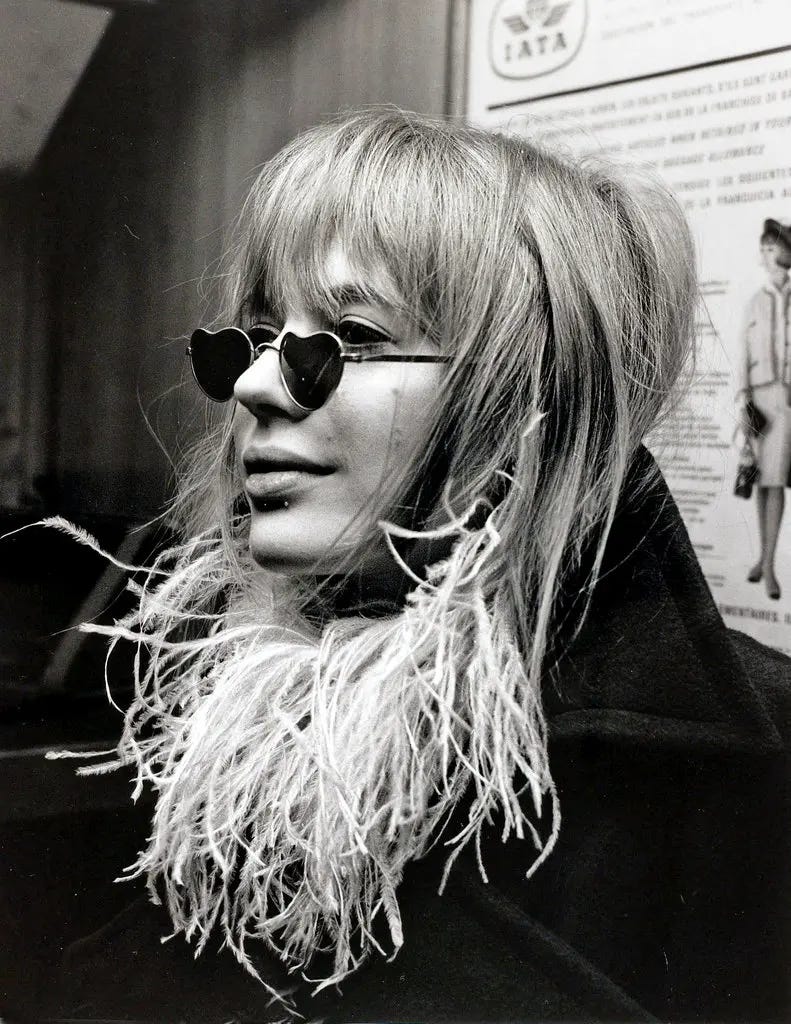
A fascinating portion of Faithfull’s memoir is spent contemplating the cult of celebrity, or the ways in which fame changes the people around her, herself included. This fuses with her thoughts on women in rock music, namely the rejection of the misogyny that pervades it, and in turn, the treatment of women by the male musicians at the forefront. Faithfull is both artist and fan, alternating between these two roles in an attempt to reconcile with her past. She professes her love for Bob Dylan early on in her story, and as she infiltrates the inner circles of the Rolling Stones, The Beatles, and even Dylan, she quickly learns that women are held to an entirely different standard, one that is reliant on the assumed inflation of the male ego through praise, sex, and devotion. She writes of a time when Dylan blatantly flirted with her, and, rejecting his advances, fled the hotel in which she spent days quite literally at his feet:
“I was the chosen one, the sacrificial virgin… Another one of those women who followed [Bob] Dylan around; women whose souls (I assumed) had been sucked dry by breaking the taboo and copulating with the god, and who were now condemned to wander in a ghostly procession through expensive hotel lobbies: Joan Baez, Suze Rotello. Zombies of the Mystic Bob.”
The religious, mythic imagery only amplifies the grip that Dylan held on the people around him, to which Faithfull almost fell victim. I found this part of the book to be striking, not only in its candor but in the relevance the dynamic presented still holds today. The underlying toxicity of the artist-fan relationship in music culture continually shocks me, and to read from Faithfull’s exploration of both sides of the spectrum is captivating. As her fame rises, she quickly becomes disillusioned with the status it grants, and learns that her once-idols are no more than clueless young men who happened to be widely adored. Recounting a time she witnessed Dylan and The Beatles meet for the first time: “It wasn’t so much a matter of being cool; they were too young to be genuinely cool. Like teenagers, they were all afraid of what the others might think and simply froze in each other’s company… I thought, ‘Jesus, how could I ever have thought these scared little boys were gods?’” Faithfull expertly humbles every so-called rockstar she encounters, seeing right through their facades and reminding the reader that musicians are not gods, but glorified performers: “It’s a simpleminded point of view, the idea that your icons really are what they appear to be.”
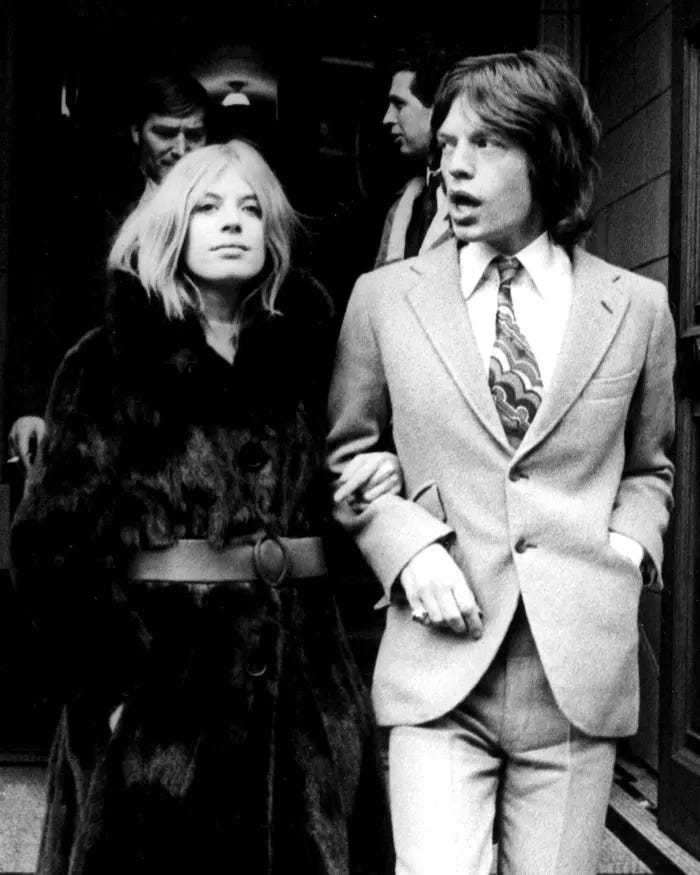
As expected, Faithfull spends a lot of her memoir reminiscing on her time with Mick Jagger and the Stones. Her fate as the ‘muse’ comes into play when considering the way her & Jagger’s relationship is portrayed in pop culture and the media. It is as though her music career was cast aside in favor of Jagger’s, and she was doomed to bear the title of “Mick Jagger’s girlfriend” and assume the role of the submissive trophy partner. In Faithfull, she reflects on this characterization with a brazen sense of self-awareness. She does not recount her relationship through rose-colored glasses, nor is she outwardly critical of Jagger; instead, she focuses on being candid, especially when addressing the faults of being a rockstar’s muse:
“What Chrissie [Shrimpton] and I shared was the most curious and lamentable fate of the pop star’s girlfriend. On the one hand you are elevated to the enviable role of Idol’s Consort. On the other hand your life becomes fair game for the press, the public and the star himself to do with what he wishes… I was to become the tormented specimen, writhing on the pin. When your personal pain becomes material for songs and the songs become hit singles, the process is strangely unnerving, however flattering it may at first seem.”
One of my favorite quotes from the entire memoir, Faithfull eloquently surmises the double-edged sword of the muse, immortalized in her partner’s art yet criticized for her very existence — and it seems that no one understands this positioning more than Faithfull herself. Misogyny and rock ‘n’ roll, alas, go hand-in-hand, between the abuse across multiple sectors from male rockstars to the subsequent mistreatment by the public and the media. While Faithfull is blatantly angered at the way she was portrayed and ridiculed (simply for existing alongside the most famous musician of the time), she makes it clear that she held just as much — if not more — power in her relationship and over her self-presentation.
Rock ‘n’ roll, then, goes beyond a music genre, or even a lifestyle: it is a cult fueled by narcissism and self-indulgence, a deadly combination that Faithfull becomes intimately familiar with over time. As is widely understood when thinking about the dangers of fame and fortune, vices have become part of the lure that surrounds rock culture. Faithfull’s struggles with addiction have, unfortunately, dominated her public perception, which is, to put it simply, a disgrace at the hands of the media. I did not wish to go into Faithfull’s struggles in this piece because it has been discussed at nauseating length already — all of which she does not deserve. I felt compelled to write about her memoir because it became clear to me from the first page that she possesses such strength and security in her self-image, and this is rarely discussed when she is mentioned in public discourse. Faithfull is remorseful, but not regretful. She expresses her faults, but also how she learned and grew from them; she does not victimize herself, but owns her mistakes and claims them as integral parts of her identity.
With this, I deeply admired how she wrote about her life, the good and the bad, with a level of consciousness that did not abide by the standard “rock ‘n’ roll glory days” narrative that so many other memoirs follow. Rather, she bares all facets of her character in earnest: she is unashamed to express whom she was a fan of; she names members of rock royalty not for the sake of plainly naming famous people, but because they were vital to her identity; and above all, she is honest, a character trait that not many famous figures possess (whether we realize it or not). My respect for Marianne Faithfull grew tremendously while reading her story, and I hope that she is remembered as the rebellious survivor she has grown to become.
Referenced: Faithfull, Marianne and David Dalton. Faithfull. Little, Brown, & Company, 1994.